


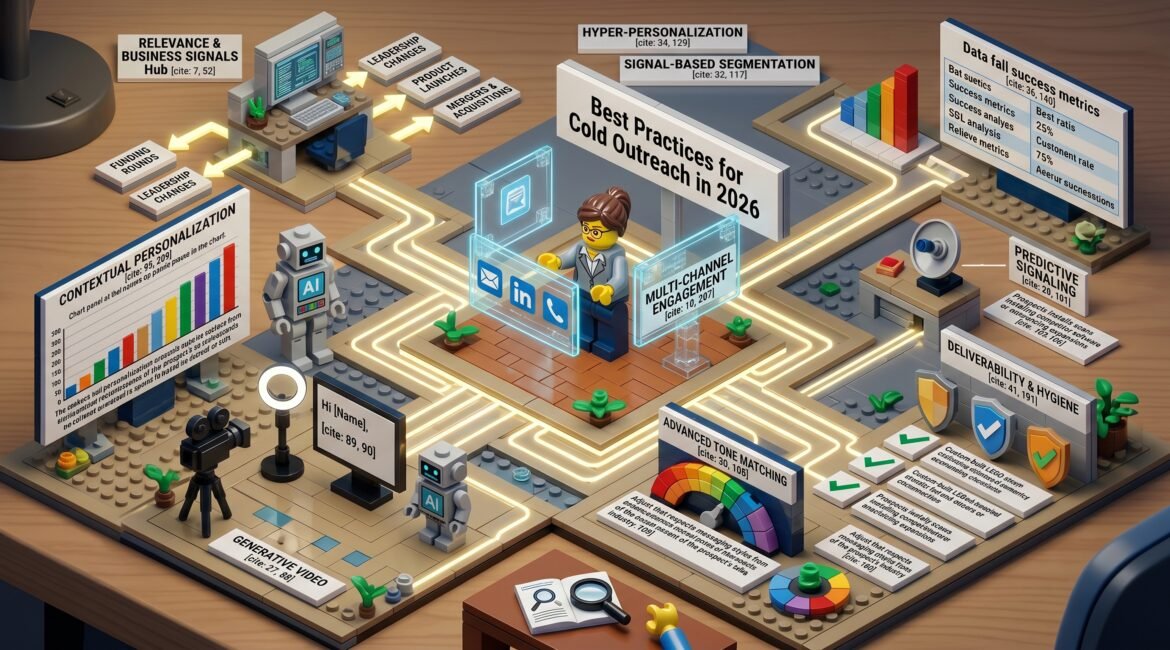
A Comprehensive Guide for Effective Prospecting
Cold outreach remains a cornerstone of B2B sales and lead generation strategies in 2026, offering businesses a proactive way to connect with potential clients. Despite evolving buyer behaviors and increasing digital noise, cold outreach continues to deliver results when executed thoughtfully and strategically. However, the traditional volume-driven approach has become obsolete, replaced by a focus on relevance, personalization, and multi-channel engagement.
The modern landscape of cold outreach is shaped by three critical factors:
- Inbox Overload and Buyer Fatigue: B2B buyers are inundated with over 120 sales-related emails per week, making generic, template-based outreach ineffective (Salesmotion). To stand out, sales teams must anchor their messaging to specific business signals, such as leadership changes, funding announcements, or earnings reports.
- The Shift to Personalization: Buyers now expect tailored communication that demonstrates a deep understanding of their needs and challenges. Personalization goes beyond using a recipient’s name; it involves crafting messages that address specific pain points and offer actionable solutions (Hypergen).
- Multi-Channel Strategies: Combining email, phone, and LinkedIn in coordinated sequences has proven to generate 40% higher engagement compared to single-channel outreach (Salesmotion). Multi-channel approaches ensure that prospects are reached through their preferred communication mediums, increasing the likelihood of meaningful interactions.
The key to successful cold outreach lies in balancing automation with genuine human effort. While tools can streamline research and targeting, the messaging itself must remain authentic and relevant. For instance, investing just five minutes in account research before reaching out can lead to 3-5x higher reply rates (Salesmotion).
Moreover, cold outreach is not without its challenges. Poorly executed campaigns can harm a brand’s reputation and lead to low response rates. To mitigate these risks, businesses must adhere to best practices, including defining an ideal customer profile (ICP), crafting concise and compelling messages, and respecting legal and ethical guidelines such as the CAN-SPAM Act (Mailerfind).
This report is a research on the most effective strategies, tools, and frameworks for cold outreach in 2026. By focusing on relevance, personalization, and multi-channel engagement, businesses can transform cold outreach from a transactional activity into a relationship-building opportunity that drives tangible results.
Table of Contents
- Understanding the Importance of Relevance in Cold Outreach
- Aligning Messaging with Recipient Needs
- The Role of Business Signals in Driving Engagement
- Multi-Channel Relevance Strategies
- Balancing Personalization and Relevance
- Measuring the Impact of Relevance
- Strategies for Personalization and Multi-Channel Sequences
- Leveraging Contextual Personalization for Enhanced Engagement
- Integrating Generative Video for Humanized Outreach
- Dynamic Multi-Channel Orchestration
- Predictive Signaling for Timely Outreach
- Advanced Tone Matching for Industry-Specific Communication
- Unified Platforms for Seamless Execution
- Signal-Based Segmentation for Targeted Campaigns
- Optimizing Cadences for Different Personas
- AI-Driven Microservices for Hyper-Personalization
- Multi-Channel Echo Effect for Reinforced Messaging
- Measuring Success and Refining Cold Outreach Campaigns
- Tracking Key Performance Metrics
- Leveraging Feedback for Continuous Improvement
- Optimizing Campaigns Through Iteration
- Advanced Analytics and AI Integration
- Addressing Deliverability Challenges
Understanding the Importance of Relevance in Cold Outreach
Aligning Messaging with Recipient Needs
Relevance in cold outreach begins with aligning your messaging to the specific needs, challenges, and goals of the recipient. Unlike generic templates, which often fail to resonate, relevance-driven communication demonstrates a deep understanding of the recipient’s context. According to Salesmotion, cold outreach campaigns anchored to real business signals—such as leadership changes, funding rounds, or earnings commentary—achieve 3-5x higher reply rates compared to template-based outreach. This data underscores the importance of tailoring outreach to address the recipient’s unique circumstances.
To achieve this alignment, sales teams should invest in research to identify key pain points or opportunities. For example, referencing a recent industry trend or company milestone can make the outreach feel timely and valuable. This approach not only captures attention but also positions the sender as a knowledgeable partner rather than a generic salesperson.
The Role of Business Signals in Driving Engagement
Business signals are critical for creating relevance in cold outreach. These signals include specific events or changes within a prospect’s organization, such as new leadership appointments, product launches, or market expansions. According to Hypergen, intent-based targeting—focusing on prospects exhibiting buying signals—significantly improves engagement rates. By anchoring outreach to these signals, businesses can demonstrate that their message is not only personalized but also timely and contextually relevant.
For instance, if a company has recently raised funding, outreach could focus on how the sender’s solution can help scale operations or optimize new investments. Similarly, if a prospect has launched a new product, the messaging could highlight how the sender’s offering complements or enhances the product’s success. This level of specificity helps differentiate the outreach from generic pitches and increases the likelihood of a positive response.
Multi-Channel Relevance Strategies
Relevance is not limited to email; it should extend across all outreach channels, including phone calls, LinkedIn messages, and even social media interactions. A coordinated multi-channel approach ensures that the messaging remains consistent and relevant, regardless of the platform. According to Sandler Training Center, combining email, phone, and LinkedIn touchpoints in a strategic sequence can boost engagement by 40% compared to single-channel outreach.
Each channel offers unique opportunities to demonstrate relevance. For example, LinkedIn allows for engagement with a prospect’s posts or articles, which can serve as a conversation starter. Phone calls, on the other hand, provide an opportunity to discuss specific challenges or opportunities in real-time. By tailoring the messaging to the strengths of each channel, businesses can create a cohesive and impactful outreach strategy.
Balancing Personalization and Relevance
While personalization focuses on tailoring messages to individual recipients, relevance ensures that the content of the message addresses their specific needs or challenges. The synergy between these two elements is crucial for effective cold outreach. As highlighted by Michael Carter on LinkedIn, the most effective outreach strategies intertwine personalization with relevance, creating messages that are both engaging and valuable.
For example, personalization might involve addressing the recipient by name or referencing their role within the company. Relevance, on the other hand, could involve discussing how the sender’s solution addresses a specific pain point or aligns with the recipient’s strategic goals. By combining these elements, businesses can create outreach messages that feel both personal and meaningful, increasing the likelihood of a positive response.
Measuring the Impact of Relevance
To ensure that relevance is driving results, businesses should track key metrics such as reply rates, engagement rates, and conversion rates. According to Salesmotion, top-performing teams achieve reply rates of 15-25% by combining tight ICP (Ideal Customer Profile) targeting with signal-anchored personalization. These metrics provide valuable insights into the effectiveness of the outreach strategy and highlight areas for improvement.
In addition to quantitative metrics, qualitative feedback from prospects can also provide valuable insights. For example, if recipients frequently mention that the outreach felt timely or relevant, it indicates that the strategy is resonating. Conversely, if recipients often express confusion or disinterest, it may signal a need to refine the messaging or targeting criteria.
By continuously analyzing these metrics and incorporating feedback, businesses can refine their outreach strategies to maximize relevance and drive better results.
Strategies for Personalization and Multi-Channel Sequences
Leveraging Contextual Personalization for Enhanced Engagement
While basic personalization like using names and titles has become standard practice, advanced contextual personalization has emerged as a critical strategy for cold outreach in 2026. This approach goes beyond superficial details to incorporate deeper insights into a prospect’s context, such as recent challenges, shared interests, or specific business events. For example, referencing a prospect’s recent funding round or a leadership change demonstrates a deeper understanding of their situation, increasing the likelihood of engagement.
Data from Sendr.ai highlights that contextual personalization can boost reply rates from the generic 1-2% to as high as 15-18%. This significant improvement underscores the importance of moving from identity-based personalization to context-driven messaging.
Integrating Generative Video for Humanized Outreach
Generative video technology has become a game-changer in personalizing cold outreach at scale. By creating unique, AI-generated videos that address prospects by name and reference specific details about their business, companies can significantly enhance the human element of their outreach. Platforms like Sendr.ai lead this space, enabling businesses to produce thousands of personalized videos efficiently.
This strategy is particularly effective in industries where trust and relationship-building are paramount. Video outreach adds a face and voice to the communication, making it more relatable and memorable. Prospects are more likely to engage with a personalized video message than a plain-text email, especially when the content is tailored to their unique circumstances.
Dynamic Multi-Channel Orchestration
In 2026, successful cold outreach strategies rely on orchestrating multiple communication channels—email, LinkedIn, and phone calls—into a cohesive narrative. Unlike traditional methods that treat each channel as a silo, modern multi-channel orchestration ensures that messaging, timing, and personalization are synchronized across all touchpoints.
According to Salesmotion, multi-channel sequences generate 40% higher engagement than single-channel approaches. Effective orchestration involves planning 8-12 touchpoints per prospect, combining emails, LinkedIn messages, and phone calls in a structured cadence. For instance, an initial email can be followed by a LinkedIn connection request, with a phone call as a follow-up to reinforce the message.
This approach not only increases the chances of reaching the prospect but also ensures that the outreach feels consistent and professional, rather than disjointed or spammy.
Predictive Signaling for Timely Outreach
Predictive signaling leverages real-time data triggers to identify the optimal moments for outreach. For example, if a prospect installs a competitor’s software or announces a new product launch, these events serve as signals that they might be open to exploring alternative solutions. By acting on these triggers, sales teams can ensure their outreach is timely and relevant.
Platforms like Sendr.ai and Apollo integrate predictive analytics to automate this process, enabling sales teams to focus on crafting personalized messages rather than identifying opportunities manually. This strategy not only improves efficiency but also enhances the likelihood of engagement by aligning outreach with the prospect’s current needs.
Advanced Tone Matching for Industry-Specific Communication
Another innovative strategy in 2026 is the use of advanced language models (LLMs) to match the tone of outreach messages to the prospect’s industry. For instance, a formal tone might be more appropriate for finance professionals, while a casual tone could resonate better with tech startups.
This level of customization ensures that the message feels natural and relatable to the recipient, increasing the likelihood of a positive response. According to Sendr.ai, tone matching is a critical component of humanized outreach, as it demonstrates an understanding of the prospect’s professional environment and communication preferences.
Unified Platforms for Seamless Execution
The era of fragmented sales tech stacks is over. In 2026, leading platforms consolidate data management, enrichment, email sequencing, and multi-channel outreach into a single, unified environment. This integration eliminates inefficiencies and data silos, enabling sales teams to execute personalized, multi-channel campaigns seamlessly.
For example, Sendr.ai-in-2026) offers a vertically integrated solution that combines all aspects of sales prospecting, from lead discovery to multi-channel outreach. This approach not only streamlines operations but also ensures that data fidelity and speed are maintained throughout the process.
Signal-Based Segmentation for Targeted Campaigns
Dynamic segmentation based on real-time signals is another cornerstone of effective cold outreach in 2026. Unlike static segmentation, which relies on predefined criteria, dynamic segmentation evolves based on a prospect’s behavior and engagement. For instance, segments can be updated based on email opens, LinkedIn interactions, or visits to key website pages.
This strategy allows sales teams to focus their efforts on high-potential accounts while avoiding over-solicitation of low-responding prospects. As noted by Haliro, dynamic segmentation ensures that outreach campaigns are both efficient and effective, maximizing the return on investment.
Optimizing Cadences for Different Personas
A one-size-fits-all approach to outreach cadences is no longer effective. In 2026, successful campaigns are tailored to the preferences and expectations of different personas. For example, a C-level executive might prefer an initial email followed by a phone call, while an operations director might respond better to LinkedIn messages.
As highlighted by Haliro, building cadences by persona involves defining the preferred entry channel, expected level of personalization, and optimal frequency of touchpoints for each target group. This level of customization ensures that outreach efforts resonate with the recipient, increasing the likelihood of engagement.
AI-Driven Microservices for Hyper-Personalization
Hyper-personalization, driven by AI-based microservices, is transforming user experiences into strategic assets. These microservices dynamically adapt interactions to the user’s context, preferences, and behavior, enabling a level of personalization that was previously unattainable.
According to Quantion, sectors such as education, healthcare, and transportation are already leveraging this technology to improve operational efficiency and strengthen customer relationships. In the context of cold outreach, hyper-personalization ensures that every interaction feels tailored to the prospect’s unique needs, significantly enhancing engagement rates.
Multi-Channel Echo Effect for Reinforced Messaging
The multi-channel echo effect involves reinforcing messages across different platforms to increase their impact. For example, a voicemail can reference an email that was sent earlier, creating a cohesive narrative that captures the prospect’s attention.
As noted by Salesmotion, combining voicemails with email signals can deliver a 47% higher connect rate during peak calling windows. This strategy not only increases the chances of reaching the prospect but also ensures that the messaging feels consistent and professional.
By implementing these advanced strategies for personalization and multi-channel sequences, businesses can significantly enhance the effectiveness of their cold outreach campaigns in 2026.
Measuring Success and Refining Cold Outreach Campaigns
Tracking Key Performance Metrics
To measure the success of cold outreach campaigns, tracking key performance metrics is essential. These metrics provide actionable insights into the effectiveness of outreach strategies and help identify areas for improvement. While existing content highlights reply rates and engagement rates, this section delves deeper into additional critical metrics and their implications.
- Open Rates: Open rates are a foundational metric that indicates how well subject lines and sender reputations are performing. In 2025, average open rates ranged between 40% and 60% (Mailforge). Moving into 2026, maintaining or exceeding this benchmark requires clean email lists, strong sender reputations, and compelling subject lines.
- Bounce Rates: A bounce rate below 2% is considered optimal (Prospeo). High bounce rates damage domain reputations and reduce deliverability. Regular email verification and list hygiene are critical to keeping bounce rates low.
- Reply Rates: While reply rates averaged 3.43% across industries in 2025, top-performing campaigns achieved reply rates of 10.7% or higher (Prospeo). This metric reflects the relevance and personalization of outreach efforts.
- Positive Response Rates: Positive responses, where recipients express genuine interest, averaged around 2% in 2025 (Mailforge). This metric is more meaningful than general reply rates, as it directly correlates with potential conversions.
- Meeting Booking Rates: Successful campaigns in 2026 report meeting booking rates of 15-20% when leveraging advanced personalization and multi-channel sequences (Lead Gen Jay).
Leveraging Feedback for Continuous Improvement
While quantitative metrics provide valuable insights, qualitative feedback from prospects is equally important for refining cold outreach campaigns. Unlike existing content that briefly mentions qualitative feedback, this section explores specific strategies for gathering and utilizing feedback effectively.
- Analyzing Prospect Responses: Review email replies to identify recurring themes in feedback. For example, if prospects frequently mention that the outreach felt generic, it may indicate a need for improved personalization.
- Surveys and Polls: Incorporate short surveys or polls in follow-up emails to gather direct feedback on the outreach experience. Questions can focus on the clarity of the message, relevance to the recipient, and overall impression.
- A/B Testing: Use A/B testing to experiment with different subject lines, email structures, and call-to-action (CTA) phrases. Analyze the results to identify which variations resonate most with the target audience.
- CRM Notes and Tags: Utilize CRM systems to tag and categorize feedback, making it easier to identify patterns and trends over time. This approach ensures that feedback is actionable and integrated into future campaigns.
Optimizing Campaigns Through Iteration
Refining cold outreach campaigns is an iterative process that requires ongoing testing and adjustments. While existing content emphasizes the importance of monitoring metrics, this section focuses on practical steps for iterative campaign optimization.
- Message Refinement: Regularly update email templates based on performance data. For example, if open rates are declining, experiment with more engaging subject lines or preview text.
- Targeting Adjustments: Reassess the Ideal Customer Profile (ICP) periodically to ensure that outreach efforts are aligned with the most promising segments. Dynamic segmentation based on real-time signals, such as website visits or LinkedIn interactions, can enhance targeting (Prospeo).
- Sequence Optimization: Analyze the performance of multi-touch sequences to identify the most effective touchpoints. For instance, campaigns with 4-7 touches tend to perform better, with a significant portion of replies occurring after the first touch (Prospeo).
- Timing and Frequency: Test different sending times and frequencies to determine the optimal cadence for each persona. For example, Tuesdays and Wednesdays are often the best days for sending cold emails (Prospeo).
- Channel Integration: Incorporate additional channels, such as LinkedIn or phone calls, into the outreach strategy to create a cohesive multi-channel experience. This approach increases engagement and reinforces messaging (Salesmotion).
Advanced Analytics and AI Integration
In 2026, advanced analytics and artificial intelligence (AI) play a pivotal role in measuring and refining cold outreach campaigns. This section explores how these technologies can enhance campaign performance, building on existing content that briefly mentions AI tools.
- Predictive Analytics: Use predictive analytics to identify high-potential prospects based on historical data and behavioral patterns. This approach allows sales teams to prioritize leads with the highest likelihood of conversion.
- Sentiment Analysis: Implement AI-powered sentiment analysis tools to assess the tone and sentiment of prospect responses. This data can help refine messaging and identify opportunities for deeper engagement.
- Performance Dashboards: Leverage advanced analytics platforms to create real-time performance dashboards. These dashboards provide a comprehensive view of campaign metrics, enabling faster decision-making and adjustments.
- AI-Driven Personalization: Use AI tools to automate and scale personalization efforts. For example, AI can generate tailored email content based on a prospect’s LinkedIn activity or recent company news (Expandi).
Automated Iteration: AI can also automate the iterative process by continuously testing and optimizing email templates, subject lines, and sequences. This ensures that campaigns remain effective without requiring constant manual intervention.
Addressing Deliverability Challenges
Deliverability is a critical factor in the success of cold outreach campaigns, yet it is often overlooked. This section provides a detailed examination of deliverability challenges and solutions, complementing existing content that briefly touches on this topic.
- Email Authentication: Ensure that email authentication protocols, such as SPF, DKIM, and DMARC, are correctly configured to prevent emails from being flagged as spam (Mailforge).
- Domain Reputation Management: Monitor domain reputation regularly using tools like Google Postmaster. Avoid sending cold emails from primary business domains to protect their reputation (Prospeo).
- List Hygiene: Maintain clean email lists by removing invalid or unresponsive contacts. Use email verification tools to ensure that all addresses are active and accurate (Oppora).
- Avoiding Spam Triggers: Craft email content that avoids common spam triggers, such as excessive capitalization, exclamation marks, and overly promotional language.
- Warm-Up Strategies: Gradually increase email sending volumes to warm up new domains and IP addresses. This process helps establish a positive sending reputation and improves deliverability rates.
By implementing these strategies, businesses can overcome deliverability challenges and ensure that their cold outreach campaigns reach the intended audience effectively.
Conclusion
The research highlights that the cornerstone of effective cold outreach lies in achieving a balance between personalization and relevance, with a strong emphasis on leveraging real-time business signals and multi-channel strategies. Personalization, such as addressing recipients by name or referencing their role, must be complemented by relevance, which involves addressing specific pain points, challenges, or opportunities unique to the recipient’s context. Data-driven insights, such as those from Salesmotion, reveal that campaigns anchored to timely business signals like funding rounds or leadership changes can achieve reply rates 3-5 times higher than generic outreach efforts. Additionally, integrating multi-channel approaches—email, LinkedIn, and phone calls—boosts engagement by up to 40%, as noted by Sandler Training Center.
Advanced strategies, including contextual personalization, predictive signaling, and AI-driven tools, further enhance the effectiveness of outreach campaigns. Contextual personalization, which incorporates deeper insights into a prospect’s business environment, can elevate reply rates to as high as 15-18%, according to Sendr.ai. Similarly, predictive analytics and AI-powered sentiment analysis enable sales teams to identify high-potential leads and refine messaging dynamically. The integration of unified platforms for seamless execution and dynamic segmentation ensures that outreach campaigns are both efficient and targeted, maximizing return on investment.
The implications of these findings suggest that businesses must adopt a more sophisticated and data-driven approach to cold outreach. Next steps include investing in tools that enable real-time signal tracking, refining Ideal Customer Profiles (ICPs), and leveraging AI to scale hyper-personalization. Additionally, continuous measurement of key performance metrics—such as reply rates, meeting booking rates, and positive response rates—combined with qualitative feedback, will be critical for iterative improvement. By implementing these best practices, organizations can significantly enhance engagement, build stronger relationships with prospects, and drive higher conversion rates in their prospecting efforts.
References
- https://www.youtube.com/watch?v=vQSB7GXedMM
- https://hunter.io/blog/cold-email-software/
- https://expandi.io/blog/cold-email-outreach-best-practices/
- https://instantly.ai/cold-email-benchmark-report-2026
- https://www.mailforge.ai/blog/engagement-benchmarks-for-cold-emails
- https://www.autobound.ai/blog/cold-email-guide-2026
- https://www.reddit.com/r/coldemail/comments/1s4wj0k/lets_talk_about_2026_outreach_whats_actually/
- https://www.cleverly.co/blog/cold-email-outreach-best-practices
- https://www.2pointagency.com/glossary/cold-email-outreach-best-practices-2026/
- https://prospeo.io/s/outreach-best-practices
- https://leadgenjay.com/blog/cold-outreach-that-actually-works-2026s-proven-strategies
- https://www.articsledge.com/post/cold-email-outreach-software
- https://oppora.ai/blog/best-cold-email-software/
- https://prospeo.io/s/cold-outreach-strategy
- https://www.reddit.com/r/b2bmarketing/comments/1sg5nj1/every_tool_you_need_to_cold_email_in_2026/
- https://salesmotion.io/blog/cold-outreach-best-practices
- https://www.linkedin.com/posts/tiffanygonzalez42_i-got-the-weirdest-cold-outreach-over-the-activity-7412528866122072064-_WpK

