


Title: The Ultimate Guide to Account-Based Marketing (ABM) for B2B Growth
1. Introduction to Account-Based Marketing
1.1 What is Account-Based Marketing?
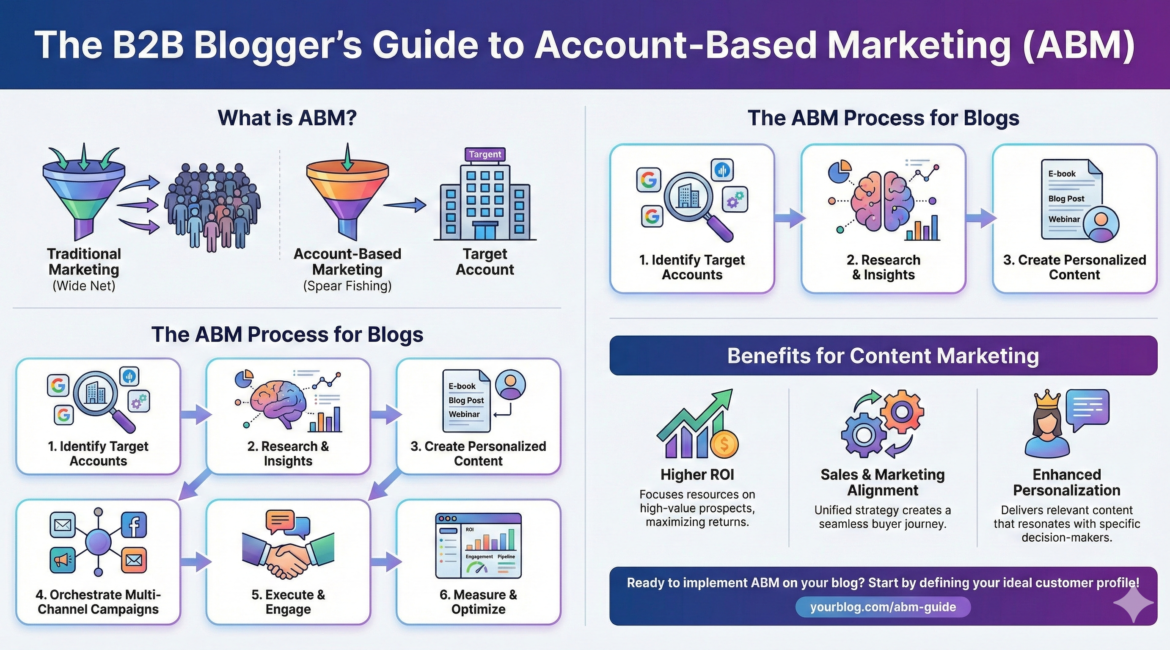
Account-Based Marketing (ABM) is a B2B growth strategy that focuses your marketing and sales resources on a clearly defined set of high-value accounts, and then uses personalized campaigns designed to resonate with each account’s specific needs and buying committee.
Instead of casting a wide net to generate as many leads as possible, ABM flips the funnel:
- Identify: Define and select specific companies (accounts) you want to win.
- Engage: Orchestrate tailored, multi-channel plays for those accounts.
- Convert & Expand: Turn them into customers, then grow revenue within those accounts.
In practice, ABM is:
- Account-centric, not lead-centric
- Highly targeted, not broad
- Deeply personalized, not generic
- Sales + marketing coordinated, not siloed
1.2 Why ABM is Transforming B2B Marketing
B2B buying has changed:
- More stakeholders: 6–10+ decision-makers in most B2B deals.
- Longer buying cycles: High-value purchases take months, sometimes years.
- Information overload: Buyers do independent research and expect relevance.
ABM responds to these realities by:
- Focusing resources on the accounts most likely to generate significant revenue.
- Treating the buying committee as a team you must influence collectively.
- Delivering context-aware experiences rather than generic campaigns.
Key benefits of ABM:
- Higher win rates and deal sizes
- Better sales and marketing alignment
- More predictable pipeline and revenue
- Stronger customer relationships and expansion opportunities
1.3 ABM vs. Traditional Lead-Based Marketing
Traditional lead-based marketing:
- Optimizes for: Volume of leads
- Measures: MQLs, form fills, email clicks
- Targeting: Broad segments (e.g., “IT managers in North America”)
- Approach: One-to-many, generic content
- Handoff: Marketing generates leads; sales follows up individually
Account-Based Marketing:
- Optimizes for: Pipeline and revenue from target accounts
- Measures: Account engagement, opportunities, revenue, expansion
- Targeting: Named accounts (e.g., “Acme Corp, Contoso, Globex”)
- Approach: One-to-one or one-to-few personalization
- Handoff: Continuous collaboration between sales and marketing
A simple way to see the difference:
- Lead-based: “How many people downloaded this eBook?”
- ABM: “Did we move Acme Corp closer to a buying decision?”
1.4 When ABM Makes Sense for Your Business
ABM isn’t right for everyone. Consider ABM if:
- Your deal sizes are relatively large (e.g., > $15–20k ACV, often higher).
- Your sales cycle is complex, with multiple stakeholders.
- You sell to specific industries, geographies, or company sizes.
- You can clearly define an Ideal Customer Profile (ICP).
- You have (or can build) close sales–marketing collaboration.
ABM might not be a fit (or only lightly used) if:
- Your product is low-priced and high-velocity (e.g., $20/month self-serve).
- Your total addressable market (TAM) is very broad with minimal differentiation.
- You don’t yet have product–market fit.
2. The Core Principles of ABM
2.1 Quality Over Quantity: Focusing on High-Value Accounts
ABM is built on the idea that not all prospects are equal. A small number of the “right” accounts can generate the majority of your revenue.
Core concepts:
- Strategic focus: Invest deeply where you see the highest potential revenue and best fit.
- Resource reallocation: Move budget and effort away from broad awareness, towards highly targeted programs.
- Tiering: Group accounts into tiers based on strategic importance and potential value (e.g., Tier 1, Tier 2, Tier 3).
Outcome: Instead of a huge top of funnel with low conversion, you have a smaller, more focused funnel with higher conversion rates and deal sizes.
2.2 Alignment Between Sales and Marketing
ABM cannot work without tight alignment. That means:
- Shared ownership of revenue: Both teams are accountable for the same business outcomes.
- Joint planning: Agree on target accounts, messaging, and plays together.
- Regular communication: Weekly or bi-weekly meetings to review progress and adjust tactics.
Characteristics of aligned ABM teams:
- A single source of truth for account lists and data (usually the CRM).
- Clearly defined roles for who does what at each touchpoint.
- Agreement on KPIs and definitions (e.g., “What counts as an engaged account?”).
2.3 Personalization at Scale
ABM requires you to personalize:
- By account: Industry, company priorities, business model.
- By persona: Role, seniority, responsibilities, pain points.
- By buying stage: Awareness, consideration, decision, expansion.
Personalization includes:
- Tailored email outreach mentioning account-specific initiatives.
- Customized landing pages with the company name, logo, and relevant case studies.
- Ads that speak directly to industry-specific challenges.
- Content that aligns with known technologies, competitors, or triggers.
“Personalization at scale” doesn’t mean everyone gets a 100% unique experience; it means using templates, modular content, and smart automation to make personalization efficient.
2.4 Data-Driven Targeting and Measurement
ABM is powered by data, not intuition alone:
- Targeting data: Firmographic (industry, size, revenue), technographic (tools used), intent (what they’re actively researching).
- Engagement data: Website visits, content consumption, event attendance, ad interactions.
- Outcome data: Opportunities created, pipeline value, closed-won deals.
Use data to:
- Select and prioritize accounts.
- Customize outreach and messaging.
- Measure and optimize what’s working at the account level.
3. Types of ABM Approaches
3.1 One-to-One ABM (Strategic ABM)
- What it is: Highly customized programs for a small number of top-tier, high-value accounts.
- Volume: Typically 5–50 accounts, depending on your resources.
- Personalization: Deep research, bespoke content, tailored plays.
- Example: A dedicated ABM pod builds a fully customized campaign for a Fortune 500 account, including executive roundtables, custom business cases, and account-specific microsites.
Best for:
- Very large deals (e.g., enterprise accounts).
- Strategic logos that have outsized brand or revenue impact.
3.2 One-to-Few ABM (ABM Lite)
- What it is: Targeted programs for small groups of accounts that share similar characteristics (industry, use case, region, etc.).
- Volume: Dozens to a few hundred accounts, grouped into clusters.
- Personalization: Semi-customized content and plays at the segment or cluster level.
- Example: A campaign for 50 SaaS companies with 500–2000 employees, with industry-specific content and tailored messaging by persona.
Best for:
- Mid-market segments.
- When you have enough commonalities across accounts to reuse assets effectively.
3.3 One-to-Many ABM (Programmatic ABM)
- What it is: Broad ABM programs that use technology to deliver personalized experiences to hundreds or thousands of accounts.
- Volume: Hundreds to thousands of accounts.
- Personalization: Automated, rules-based; often focused on website and ad personalization.
- Example: Tailored ad campaigns and website experiences for 1,500 accounts that fit your ICP, with dynamic content blocks based on industry and buyer role.
Best for:
- Large TAM with clear ICP criteria.
- Scaling ABM after initial success with smaller programs.
3.4 How to Choose the Right ABM Model
Consider:
- Deal size / strategic value:
- Highest value → One-to-one
- Medium value → One-to-few
- Lower (but still meaningful) value → One-to-many
- Team capacity:
- Fewer resources → Start with one-to-many or a small one-to-few pilot.
- Data and tech maturity:
- Limited tech/data → One-to-few and manual personalization.
- Strong tech stack → Programmatic, one-to-many at scale.
Many organizations use a hybrid approach:
- Tier 1: One-to-one
- Tier 2: One-to-few
- Tier 3: One-to-many
4. Laying the Foundation: Cross-Functional Alignment
4.1 Getting Sales Buy-In for ABM
ABM succeeds only when sales is fully on board.
Steps to secure buy-in:
- Involve sales early: Co-create the target account list and campaign plays.
- Align on goals: Show how ABM helps sales close more and bigger deals.
- Pilot first: Start with a small, visible pilot involving a few motivated reps.
- Share wins quickly: Highlight early successes (meetings, pipeline, deals).
Position ABM as:
- A way to augment sales efforts, not replace them.
- A framework to help reps focus on their best bets.
4.2 Defining Shared KPIs and Success Metrics
Agree on metrics that reflect joint ownership:
- Top-of-funnel: Number of target accounts engaged, engagement score.
- Mid-funnel: Meetings booked, opportunities created, pipeline generated from target accounts.
- Bottom-of-funnel: Win rate, deal size, sales cycle length for target accounts.
- Post-sale: Expansion revenue, renewals, NPS in ABM accounts.
Turn these into a scorecard that both marketing and sales review regularly.
4.3 Creating an ABM Task Force or Pod
For serious ABM, form a cross-functional ABM pod:
- Marketing: ABM strategist, demand gen, content marketer, marketing operations.
- Sales: Sales leader, a few account executives (AEs), sales development reps (SDRs/BDRs).
- Others (as needed): Customer success, product marketing, sales ops, data/BI.
Responsibilities:
- Develop target account lists and tiers.
- Design and run campaigns (“plays”).
- Share insights and feedback quickly.
- Iterate based on account-level outcomes.
4.4 Establishing Clear Roles and Responsibilities
Define who does what across the customer journey:
- Marketing:
- Builds and maintains target account lists.
- Designs campaign strategy, messaging, and content.
- Runs ads, events, and website personalization.
- Sales:
- Prioritizes accounts and contacts.
- Executes personalized outreach and follow-up.
- Provides account insights and feedback.
- Shared:
- Account planning sessions.
- Pipeline reviews by account.
- Nurturing relationships with buying committees.
Document these roles in a playbook so everyone is aligned.
5. Identifying and Selecting Target Accounts
5.1 Building Your Ideal Customer Profile (ICP)
Your ICP is a data-informed description of the accounts most likely to succeed and generate significant value with your solution.
To build an ICP:
- Analyze your best customers:
- High ARR/LTV
- Strong product adoption and retention
- Fastest sales cycles
- Look for patterns:
- Firmographics: Industry, company size, region, revenue.
- Technographics: Tools, platforms, complementary technologies.
- Business characteristics: Business model (B2B/B2C), growth stage, regulatory environment.
- Document your ICP:
- “Our best-fit customers are typically:
- SaaS companies
- 200–2,000 employees
- Using Salesforce and a popular marketing automation platform
- Located in North America and Western Europe
- With a sales-led motion and complex buying cycles.”
This ICP becomes your filter for target account selection.
5.2 Using Firmographic, Technographic, and Intent Data
To find and prioritize accounts:
- Firmographic data:
- Source: ZoomInfo, Clearbit, LinkedIn, company registries.
- Use to ensure companies match your ICP basics (size, industry, location).
- Technographic data:
- Source: BuiltWith, HG Insights, Slintel.
- Use to identify accounts using specific tools (e.g., “Using Salesforce + Marketo”) or competitors.
- Intent data:
- Source: Bombora, 6sense, Demandbase, G2.
- Use to see which accounts are actively researching your category, competitors, or key topics.
Combine these data types to:
- Build a master account universe (all accounts that fit your ICP).
- Surface high-intent accounts that should be prioritized.
- Segment accounts by technology stack and potential integration value.
5.3 Prioritizing and Tiering Your Accounts
Not all target accounts are equal. Create tiers:
- Tier 1 (Strategic):
- Highest potential revenue and strategic importance.
- Deep one-to-one treatment.
- Tier 2 (High Priority):
- Strong fit, good revenue potential.
- One-to-few programs with some individual personalization.
- Tier 3 (Broad ICP):
- Good fit but lower potential or earlier in the journey.
- One-to-many, programmatic ABM.
Prioritization criteria:
- Revenue potential (ACV/LTV).
- Strategic value (logo, market influence).
- Current relationship (existing contacts, partner ties).
- Intent and engagement signals.
5.4 Common Mistakes in Account Selection
Avoid:
- Choosing too many accounts: You spread your efforts thin and lose ABM’s power.
- Relying only on sales opinions: Good input, but back it with data.
- Ignoring negative signals: Accounts with poor retention or adoption patterns.
- Static lists: Never revising your account list as markets and signals change.
6. Deep Research and Insight Gathering
6.1 Understanding the Buying Committee and Key Stakeholders
For each target account, identify:
- Economic buyer: Usually a VP or C-level; controls budget.
- Champion: Believes in your solution and advocates internally.
- Users/influencers: People who will use your product or evaluate it.
- Gatekeepers: Procurement, legal, IT/security.
Research:
- Titles, departments, seniority.
- Responsibilities and KPIs.
- Relationship to your solution (user, approver, budget holder).
Tools and sources:
- LinkedIn (individual profiles, company pages).
- Account website (leadership, departments, press releases).
- CRM history (past opportunities, notes).
6.2 Mapping Account Pain Points, Goals, and Triggers
Understand:
- Business goals:
- Revenue targets, efficiency improvements, cost reductions.
- Challenges:
- Operational bottlenecks, outdated systems, manual processes.
- Strategic initiatives:
- Digital transformation, expansion into new markets, M&A.
- Triggers:
- Funding rounds, leadership changes, new regulations, acquisitions, product launches.
Use this to answer:
“What problem are they solving now, and how does our solution fit into their priorities?”
6.3 Tools and Data Sources for Account Intelligence
Useful tools:
- Sales/Marketing platforms:
- CRM (Salesforce, HubSpot) for historical interactions.
- MAP (Marketo, HubSpot, Pardot) for engagement history.
- External data:
- LinkedIn Sales Navigator.
- News/press aggregators (Google Alerts, Crunchbase).
- Review sites (G2, Capterra).
- Website and product analytics:
- Tools like Clearbit Reveal or 6sense to identify anonymous web traffic.
- Product usage data for existing customers.
6.4 Turning Insights into Actionable Messaging
Translate insights into messaging frameworks:
- For each segment or key account, define:
- Primary pain point.
- Desired outcome.
- Key value proposition (how you help).
- Proof points (case studies, stats, testimonials).
- Objections and responses.
Example:
- Account: Mid-market SaaS company expanding to Europe.
- Pain: Scaling revenue team while maintaining forecasting accuracy.
- Outcome: Predictable pipeline and faster ramp for new reps.
- Message: “Give your new EMEA reps the playbook and data they need to hit quota in 90 days.”
- Proof: Case study of similar SaaS company with 30% faster ramp.
7. Crafting Your ABM Strategy and Messaging
7.1 Developing Value Propositions Tailored to Each Tier
- Tier 1:
- Create account-specific value propositions.
- Reference their initiatives, language, and strategic goals.
- Tier 2:
- Use segment-based value propositions (e.g., industry-specific).
- Tier 3:
- ICP-based value propositions, with dynamic personalization (e.g., by industry and role).
Each value proposition should answer:
- “For [WHO], struggling with [PROBLEM], we provide [SOLUTION] that delivers [OUTCOME], unlike [ALTERNATIVES].”
7.2 Personalization Tactics by Role, Industry, and Stage
Personalize by:
- Role:
- C-level: Business outcomes (revenue, risk, strategy).
- Director: Team performance, KPIs, process improvements.
- Practitioner: Day-to-day workflow, tools, usability.
- Industry:
- Use industry-specific terminology.
- Reference relevant regulations, trends, and benchmarks.
- Stage:
- Early-stage: Education, problem framing, category value.
- Mid-stage: Comparisons, ROI, use cases, demos.
- Late-stage: Business case, implementation plan, risk mitigation.
7.3 Creating an ABM Content Matrix
Map content types to:
- Personas (CIO, CMO, VP Sales, Ops Lead).
- Stages (Awareness, Consideration, Decision, Expansion).
- Formats (blogs, whitepapers, videos, one-pagers, case studies, ROI calculators).
Example matrix row:
- Persona: VP Sales
- Stage: Consideration
- Content:
- “Playbook: How Revenue Leaders Build Predictable Pipeline with ABM.”
- ROI calculator for pipeline and win rate impact.
- Webinar with a similar VP Sales sharing their ABM journey.
7.4 Aligning Messaging Across Marketing and Sales Touchpoints
Ensure consistency across:
- Ads
- Website and landing pages
- Emails (marketing and sales)
- SDR/AE call scripts
- Events and webinars
- Sales decks and proposals
Create message maps that outline:
- Core narrative
- Key proof points
- Recommended talking points by persona
Share these in a central playbook so everyone is aligned.
8. ABM Channels and Tactics
8.1 Email and Sales Outreach (Sequences and Cadences)
For target accounts:
- Build multi-step sequences (SDR/AE + marketing).
- Mix:
- Personalized emails.
- Voicemail drops.
- LinkedIn touches.
- Content shares (relevant assets).
- Make outreach:
- Specific (reference account and role).
- Helpful (offer insights, benchmarks, or tools).
- Multi-threaded (aim to engage multiple stakeholders).
Example 5-step cadence:
- Email: Personalized intro with 1–2 relevant insights.
- LinkedIn: View profile + connection request with a tailored note.
- Email: Case study relevant to their industry and role.
- Call: Reference content they received and offer to share a short analysis.
- Email: Invite to a relevant webinar or executive roundtable.
8.2 Personalized Website Experiences and Landing Pages
Use personalization tools or rules to:
- Show account’s company name, logo, and industry on landing pages.
- Display:
- Industry-specific case studies.
- Relevant integrations.
- Tailored CTAs (e.g., “Talk to an expert in manufacturing sales ops”).
For Tier 1 accounts:
- Create dedicated microsites:
- Executive summaries.
- Custom ROI scenarios.
- Curated content for their buying committee.
8.3 Targeted Digital Advertising (Display, Social, Retargeting)
Use:
- Account-based advertising platforms to target your account lists.
- LinkedIn for persona-specific ads within target accounts.
- Retargeting to bring back engaged visitors and deepen their journey.
Tactics:
- Serve different ad creatives based on:
- Industry.
- Role (e.g., CFO vs. VP Sales).
- Funnel stage (education vs. demo request).
8.4 Events, Webinars, and Executive Roundtables
Events are powerful ABM levers:
- Webinars:
- Design for specific segments (e.g., “ABM for Enterprise Manufacturers”).
- Invite specific contacts at target accounts.
- Small, curated roundtables:
- 8–12 executives discussing a shared challenge.
- Position your team as facilitators and thought partners.
- In-person events or dinners:
- For Tier 1 accounts or regional clusters.
- Focus on relationship-building and strategic conversations.
8.5 Direct Mail and Gifting for High-Value Accounts
Tactile experiences stand out:
- Gift boxes tied to your message (e.g., “Unlock your pipeline” with a physical key).
- Books relevant to the recipient’s role or challenge.
- Personal notes referencing specific account initiatives.
Coordinate:
- Time gifts to arrive before or after key meetings.
- Tie them to digital campaigns and follow-up outreach.
8.6 Account-Based Social Selling
Empower sales reps to:
- Build and nurture networks within target accounts.
- Share relevant content consistently (not just product pitches).
- Engage with posts from decision-makers (thoughtful comments, not “Nice post!”).
- Participate in relevant groups and conversations.
Marketing can:
- Provide social templates and content.
- Highlight key contacts and decision-makers.
- Surface engagement intel (who’s interacting with your brand).
9. Technology Stack for ABM
9.1 Core Components: CRM, MAP, and ABM Platforms
ABM requires a core stack:
- CRM (e.g., Salesforce, HubSpot CRM):
- System of record for accounts, contacts, opportunities.
- Marketing Automation Platform (MAP) (e.g., Marketo, HubSpot, Pardot):
- Email, lead scoring, nurture, some segmentation.
- ABM Platform (e.g., Demandbase, 6sense, Terminus, RollWorks):
- Account identification and scoring.
- Intent signals.
- Account-based advertising.
- Orchestration and reporting at the account level.
9.2 Intent Data and Predictive Analytics Tools
Use intent and predictive tools to:
- Discover accounts in-market for your solution.
- Prioritize outreach and campaigns.
- Predict which accounts are most likely to convert.
Capabilities:
- Topic-level intent trends at the account level.
- Signals from content consumption, searches, forum posts, etc.
- Predictive scores that feed into your CRM and MAP.
9.3 Website Personalization and Ad Platforms
- Website personalization:
- Tools that dynamically change site content by account, industry, or segment.
- Ad platforms:
- Native ABM ad tools (Demandbase, Terminus, 6sense).
- LinkedIn Matched Audiences for account lists.
- Google and programmatic display via ABM partners.
9.4 Integrations and Data Hygiene Considerations
Crucial for ABM:
- Ensure bidirectional sync between CRM, MAP, ABM platform, and data providers.
- Regularly clean:
- Duplicates.
- Incomplete records.
- Outdated contacts (roles change frequently).
- Standardize:
- Account naming conventions.
- Industry categories.
- Country and region fields.
Poor data → poor targeting and weak personalization.
9.5 How to Start Small with ABM Tech
You don’t need everything at once:
- Start with:
- CRM + MAP + a small intent/ABM tool or ad solution.
- Focus:
- Build processes and alignment first; tools amplify what works.
- Add:
- Advanced ABM platforms and personalization later, as you prove ROI.
10. Executing an ABM Campaign: Step-by-Step
10.1 Setting Goals and Defining Success
Define clear, realistic goals such as:
- Engage 50% of Tier 1 accounts within 3 months.
- Create $X in qualified pipeline from Tier 2 accounts in 6 months.
- Increase win rate with Tier 1 accounts by Y% year-over-year.
Make goals:
- Specific (numbers, accounts, timeframes).
- Aligned with overall revenue targets.
10.2 Building Target Account Lists and Segments
- Start from your ICP and data sources.
- Group accounts into:
- Tiers (1, 2, 3).
- Segments (by industry, region, etc.).
- Validate lists with sales:
- Remove bad fits.
- Add strategic targets they know about.
Lock the list (for a period) so you can measure impact.
10.3 Designing Campaign Plays and Sequences
A “play” is a coordinated set of touches across teams and channels for a specific goal.
Example play:
- Goal: Book executive discovery meetings with 10 Tier 1 accounts.
- Tactics:
- Personalized emails from AE and SDR.
- LinkedIn connection + content share.
- Direct mail gift tied to a webinar or executive roundtable.
- Account-specific landing page and case study.
- Timeline: 3–4 weeks per cohort.
Document each play:
- Audience (who, which tier).
- Messaging and value prop.
- Channel mix and sequence.
- Owner (marketing vs. sales).
- Success metrics.
10.4 Coordinating Outreach Between Marketing and Sales
Create a campaign calendar and playbook:
- Who sends which touch, when.
- What triggers a handoff or escalation (e.g., “If they attend webinar → AE outreach within 24 hours”).
- How to log activities in the CRM for accurate reporting.
Hold weekly standups during campaigns to:
- Review account engagement.
- Share anecdotal feedback from calls and emails.
- Adjust messaging, offers, and sequences.
10.5 Examples of Effective ABM Plays
- Executive Insight Play:
- Send an industry trends report featuring data relevant to the account’s role.
- Follow with a personalized email offering a 30-minute review to map their current state to the benchmark.
- Competitive Displacement Play:
- Target accounts using a specific competitor tool.
- Serve ads and send content highlighting “5 hidden costs of [Competitor]” and a migration guide.
- Offer a migration workshop.
- Renewal & Expansion Play (Customer ABM):
- Identify high-usage accounts nearing renewal.
- Engage champions and new stakeholders with usage reports and expansion opportunities.
- Offer an executive QBR to co-create a roadmap.
11. Measuring ABM Success
11.1 Key ABM Metrics: Engagement, Pipeline, Revenue
Track at the account level:
- Engagement:
- Website visits from target accounts.
- Content consumption (downloads, webinar attendance).
- Email engagement (opens, replies, meetings booked).
- Pipeline:
- Opportunities created in target accounts.
- Pipeline value and stage progression.
- Revenue:
- Closed-won deals.
- Win rate and average deal size.
- Expansion and renewal revenue from ABM accounts.
Also track:
- Time-to-first-meeting for target accounts.
- Sales cycle length for ABM accounts vs. non-ABM.
11.2 Tracking Account Progress Through the Funnel
Visualize ABM funnel stages such as:
- Targeted → Engaged → Meeting → Opportunity → Customer → Expanded
Monitor:
- How many accounts are in each stage.
- Conversion rates between stages.
- Where accounts stall or leak out of the funnel.
Use this to prioritize plays:
- More “engagement” plays if too few accounts are moving from targeted to engaged.
- More “acceleration” plays if deals are stuck in late stages.
11.3 Multi-Touch Attribution in an ABM World
Traditional lead-based attribution (e.g., “last touch gets 100% credit”) misses ABM complexity.
In ABM, aim to:
- Attribute influence rather than only “source.”
- Consider multiple contacts and channels contributing to a deal.
- Use models (multi-touch, account-based influence) that:
- Recognize all key interactions (ads, webinars, emails, events).
- Measure impact on pipeline and revenue at the account level.
Perfect attribution is impossible; focus on directional insights to guide investment.
11.4 Reporting to Leadership and Stakeholders
Report in terms executives care about:
- Pipeline and revenue from target accounts.
- Changes in win rate, deal size, and sales cycle length for ABM accounts.
- Strategic logo wins and customer stories.
- ROI of ABM programs vs. traditional marketing efforts.
Use:
- Dashboards (in CRM/BI tools) with account-level views.
- Before-and-after comparisons for pilot vs. control groups.
- Executive summaries that highlight business outcomes, not just activity metrics.
12. Optimizing and Scaling Your ABM Program
12.1 Running Experiments and A/B Tests
Continuously test:
- Messaging angles (problem-focused vs. outcome-focused).
- Content formats (webinars vs. whitepapers vs. short videos).
- Offers (assessments, workshops, pilots).
- Channel mix (email vs. LinkedIn vs. direct mail emphasis).
Define:
- Hypothesis.
- Test and control groups.
- Timeframe.
- Success criteria.
Use findings to refine your playbooks.
12.2 Learning from Wins and Losses at the Account Level
For significant wins and losses:
- Conduct deal retrospectives:
- What worked?
- What didn’t?
- How did ABM contribute (or fail)?
- Capture:
- Messaging that resonated.
- Objections you overcame or couldn’t.
- Champions’ profiles and behavior patterns.
Feed learnings back into:
- Targeting criteria.
- Messaging frameworks.
- Content roadmap and plays.
12.3 Evolving from Pilot to Full ABM Program
Phase your growth:
- Pilot:
- Small set of accounts (e.g., 20–50).
- Limited set of plays and channels.
- Close collaboration with a few sales reps.
- Expansion:
- Add more segments, regions, or tiers.
- Increase scope (more target accounts, more pods).
- Start specialized ABM roles (e.g., ABM managers per region or segment).
- Operationalization:
- Standardized playbooks.
- Formal ABM training for sales and marketing.
- Technology fully integrated with core systems.
12.4 Scaling Across Regions, Segments, and Product Lines
Scaling requires:
- Templates and frameworks:
- Reusable playbooks that local teams can adapt.
- Local market adaptation:
- Adjust for language, culture, regulations, buying behaviors.
- Governance:
- Global standards for data, reporting, and KPI definitions.
Balance:
- Centralized strategy and tooling.
- Decentralized execution and customization.
13. Common ABM Challenges and How to Overcome Them
13.1 Lack of Sales and Marketing Alignment
Symptoms:
- Disagreements on target accounts.
- Sales ignoring marketing-sourced insights or content.
- Marketing not knowing what happens after handoff.
Solutions:
- Joint planning sessions.
- Shared KPIs and dashboards.
- Regular ABM standups and QBRs.
- Leadership support from both sides.
13.2 Data Quality and Incomplete Account Profiles
Symptoms:
- Incorrect or missing contacts.
- Duplicated accounts.
- Poor signal for intent and engagement.
Solutions:
- Invest in data enrichment tools.
- Set up data hygiene processes (ownership, SLAs for cleanup).
- Train teams on data entry best practices.
13.3 Underestimating Time and Resources Required
ABM is not a quick hack.
Challenges:
- Deep research takes time.
- Content needs to be tailored.
- Coordination across teams can be complex.
Solutions:
- Start small and focus.
- Reuse and adapt content intelligently.
- Automate where possible (without losing personalization).
13.4 Misaligned Expectations Around ROI and Timelines
Symptoms:
- Leadership expecting immediate revenue impact.
- ABM abandoned after a short pilot due to “no results.”
Reality:
- ABM’s impact often builds over quarters, not weeks, especially for long sales cycles.
Solutions:
- Set realistic expectations up front.
- Define leading indicators (engagement, meetings) as early success signs.
- Show incremental progress and wins.
14. Real-World ABM Examples and Use Cases
14.1 ABM for Enterprise Deals
Scenario:
- A SaaS vendor targets 20 Fortune 1000 accounts.
Tactics:
- One-to-one ABM with dedicated pods.
- Customized business cases and ROI models.
- Executive roundtables featuring current enterprise customers.
- Account-specific microsites with curated content and proposals.
Outcomes (illustrative):
- 5 new enterprise customers.
- 30% higher ACV vs. non-ABM deals.
- Shorter sales cycles due to stakeholder alignment and targeted content.
14.2 ABM for Mid-Market Expansion
Scenario:
- A B2B fintech company wants to grow in the 200–1,000 employee segment.
Tactics:
- One-to-few ABM by industry (e.g., SaaS, manufacturing).
- Segment-specific webinars and guides.
- LinkedIn ads to key personas in target accounts.
- Regional events to deepen relationships.
Outcomes (illustrative):
- 25% increase in qualified opportunities from target accounts.
- Improved engagement: 2x website visits and content downloads from target list.
14.3 ABM for Customer Upsell and Cross-Sell
Scenario:
- A product-led SaaS company aims to increase expansion revenue in existing customers.
Tactics:
- Identify accounts with high usage and multiple teams using the product.
- Personalized QBRs showing usage data and expansion opportunities.
- Targeted campaigns to adjacent departments within existing accounts.
- Internal champions supported with decks and ROI calculators.
Outcomes (illustrative):
- 20% increase in expansion revenue.
- Stronger executive relationships and multi-year renewal deals.
14.4 Mini Case Studies: Before and After ABM
Example 1:
Before:
- Marketing focused on generic lead gen.
- Sales chased random inbound leads.
- Win rate with large accounts: 10%.
After:
- ABM program for 100 high-value accounts.
- Coordinated plays and deep personalization.
- Win rate with target accounts: 25%.
- Average deal size up 40%.
Example 2:
Before:
- Events run for broad audiences; low ROI.
- Poor attendee quality.
After:
- Invite-only executive roundtables for target accounts.
- Follow-up ABM plays for attendees.
- 3x higher pipeline generated per event.
15. Getting Started with ABM: A 90-Day Action Plan
15.1 Phase 1 (Days 1–30): Strategy, Alignment, and Account Selection
Key actions:
- Secure leadership and sales buy-in.
- Define your ICP and build an initial target account list.
- Tier accounts and select a manageable pilot group.
- Establish KPIs and reporting structure.
- Form an ABM pod and define roles.
Deliverables:
- ICP document.
- Tiered target account list.
- ABM pilot plan and goals.
- Alignment agreement with sales.
15.2 Phase 2 (Days 31–60): Content, Plays, and Initial Launch
Key actions:
- Develop messaging frameworks per segment/tier.
- Build or adapt key content assets (case studies, landing pages, emails).
- Design 1–2 core plays for your pilot accounts.
- Set up necessary tech (tracking, segments, simple personalization).
- Train sales on plays and collateral.
Deliverables:
- ABM messaging playbook.
- Content matrix and priority content created.
- Documented plays with sequences and owners.
- Technical setup for tracking accounts and engagement.
15.3 Phase 3 (Days 61–90): Optimization, Reporting, and Scale Readiness
Key actions:
- Launch your pilot plays and run them end-to-end.
- Monitor engagement and pipeline from target accounts.
- Conduct weekly reviews with sales.
- Gather qualitative and quantitative insights.
- Refine targeting, messaging, and plays.
Deliverables:
- Pilot results report (engagement, pipeline, early revenue).
- Updated plays and next-iteration plans.
- Recommendations for scaling (more accounts, regions, or plays).
15.4 Quick Checklist for Launching Your First ABM Campaign
- [ ] Sales and marketing alignment meeting completed.
- [ ] ICP defined and documented.
- [ ] Tiered target account list agreed with sales.
- [ ] ABM pod formed with clear roles.
- [ ] Messaging framework created for key personas.
- [ ] Content assets mapped to personas and stages.
- [ ] At least one core play designed and documented.
- [ ] Tracking and reporting set up at the account level.
- [ ] Sales trained on outreach sequences and tools.
- [ ] Pilot launched with clear start/end dates and goals.
16. Conclusion
16.1 Recap: Why ABM Matters for Modern B2B Growth
ABM aligns your organization around the accounts that matter most:
- It turns random marketing activity into targeted, strategic engagement.
- It helps you win larger, more complex deals by orchestrating efforts across teams.
- It creates a more predictable, measurable path from account selection to revenue.
In a world where buyers expect relevance and coordination, ABM is no longer optional for many B2B companies—it’s a critical growth engine.
16.2 How to Evolve from Campaigns to an ABM Culture
ABM is not just a set of campaigns; it’s a way of operating:
- Think in terms of accounts and buying committees, not just leads.
- Make sales–marketing collaboration the norm, not the exception.
- Use data to continually refine who you target and how you engage them.
- Embed ABM principles into product marketing, customer success, and even partner ecosystems.
Over time, ABM shifts from “a project” to “how we go to market.”
16.3 Next Steps and Additional Resources
To go further:
- Build your first ABM pilot using the 90-day plan.
- Formalize an ABM playbook that documents your ICP, tiers, plays, and roles.
- Invest gradually in technology and data that enhance precision and scale.
- Learn from peers:
- Attend ABM-focused webinars and conferences.
- Join communities where practitioners share real experiences.
- Study case studies from companies similar to yours.
With focus, collaboration, and iteration, ABM can become one of the most powerful drivers of sustainable B2B growth in your organization.

